Spring 2025 Student Research Project: Coral Grazers
Each semester, Island School students dive into hands-on research alongside scientists from the Cape Eleuthera Institute, contributing to meaningful, place-based studies that explore the unique ecosystems of The Bahamas. These Spring 2025 research groups—focused on conch, stingrays, coral grazers, corals, lobsters, sharks, and sustainable energy—are tackling real-world questions with curiosity, collaboration, and care. In this blog series, students share their experiences, challenges, and discoveries as they navigate the research process and deepen their understanding of both science and self.
Analyzing how the diversity and density of coral grazers compares to algal cover on coral reefs in South Eleuthera
Journey M. Higgs, Lydia A. Cunningham, Henry I. Goldman, Ashenafi J. Hawgood, Angeline L. Adams, Jane A. Huffman
In The Bahamas, coral reefs have the highest diversity of life. The health of corals are an important part of Bahamian and SIDS (Small Island Developing States). The coral reef’s ecosystem services include supporting fisheries, benefiting and sustaining our economy through the exportation of resources, income generated from tourism and influence on Bahamian culture and well-being.
With the current rise in ocean temperatures, an issue globally in our oceans is an increase in macroalgae cover on coral reefs. This has since led to corals being more susceptible to bleaching and disease. With global declines in coral reef health and an increase in climate change over the past three decades, the number of bleaching events on our coral reefs have become much more frequent.1
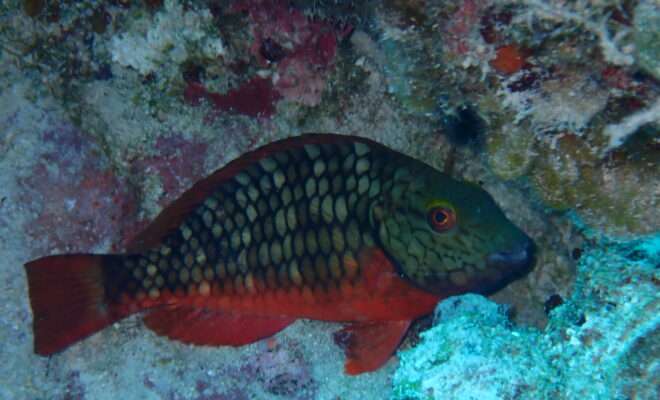
Animals such as Tripneustes sea urchins, Maguimithrax crabs, and certain types of fish such as parrot fish are labeled as grazers. “We calculated that macro algal consumption by Maguimithrax crabs alone could exceed macroalgae production with a doubling of their current low abundance.”2 These grazers are greatly important for feeding on macroalgae, which help keep the reefs clean and allow coral to be able to grow. Macroalgae takes up space on reefs and the sea floor, which often prohibits new corals from having room to settle and grow.
Objectives
To best complete our research, we conducted surveys to determine the abundance and diversity of grazers. We then measured and compared algal cover with grazer abundance and diversity. Finally, we identified key grazers on reefs in South Eleuthera.
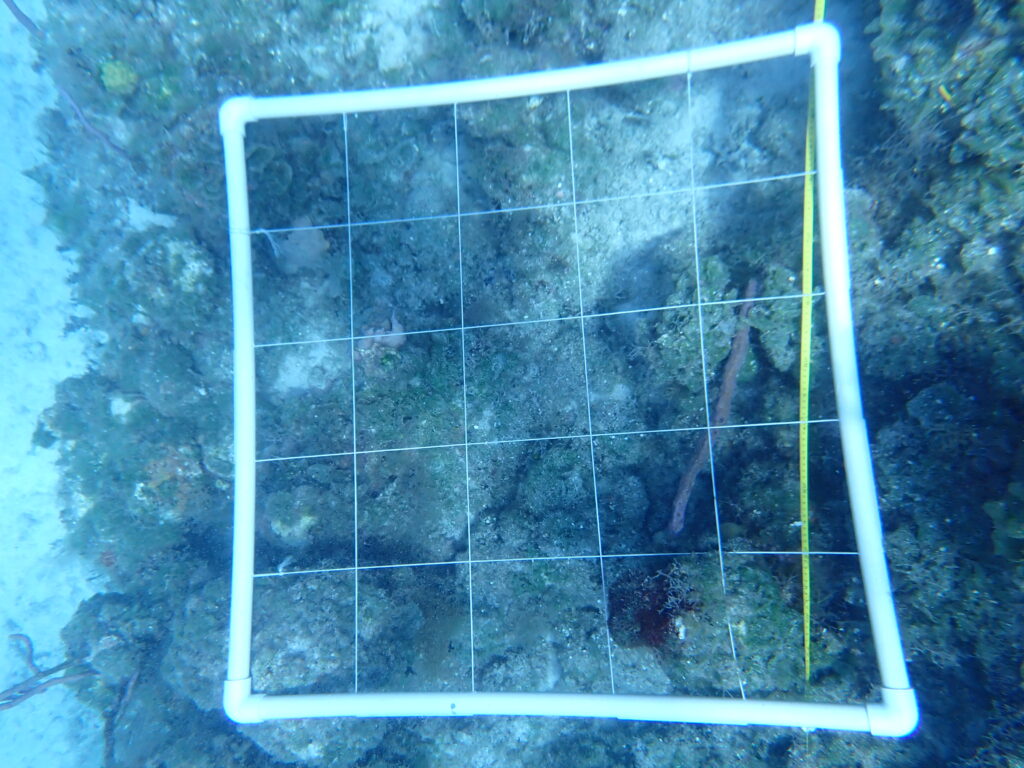
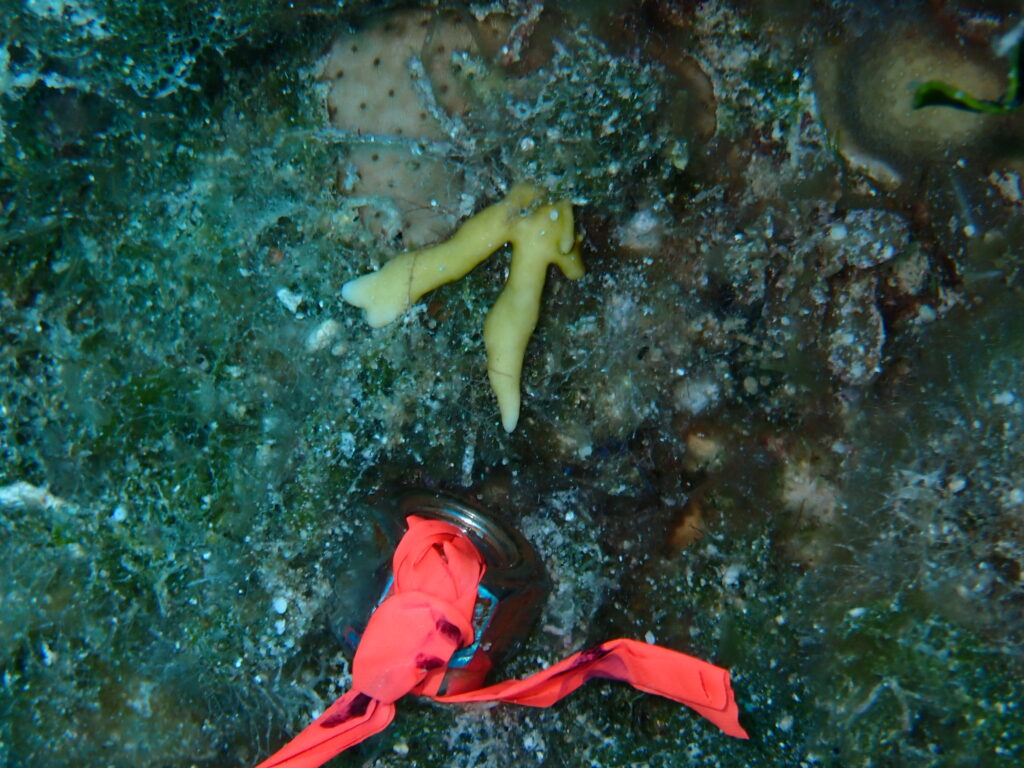
Figure 2 (left): A quadrat placed along the transect during a survey of dive site Harbour Rocks, off the coast of South Eleuthera. Figure 3 (right): A coral juvenile identified along a transect during a survey of dive site Harbour Rocks, off the coast of South Eleuthera
Hypothesis
An increase in grazer abundance and diversity will be enough to cull macroalgae overgrowth.
Methods
To determine grazing rates within coral reefs to the best of our ability we took samples of the reef. To do this, we put transects across the reef and laid quadrats to collect data. The transects were 30 feet and the quadrats were one meter by one meter. This is to act as a sample for the whole reef and to help us take productive data. The quadrats are placed next to the transects. We took four quadrats for each transect. From there, we collected data on what was found within each transect, including coral species or grazers. This was done to determine both the grazing rates around the reef, as well as the health and wellbeing of the reef. We then used this data to create an understanding of the coral bleaching in South Eleuthera.
The results from these surveys were then used to infer what the populations of grazers and coral cover are across coral reefs in general, in South Eleuthera. A conclusion can then be made regarding the overall health of these reefs in this region of The Bahamas.
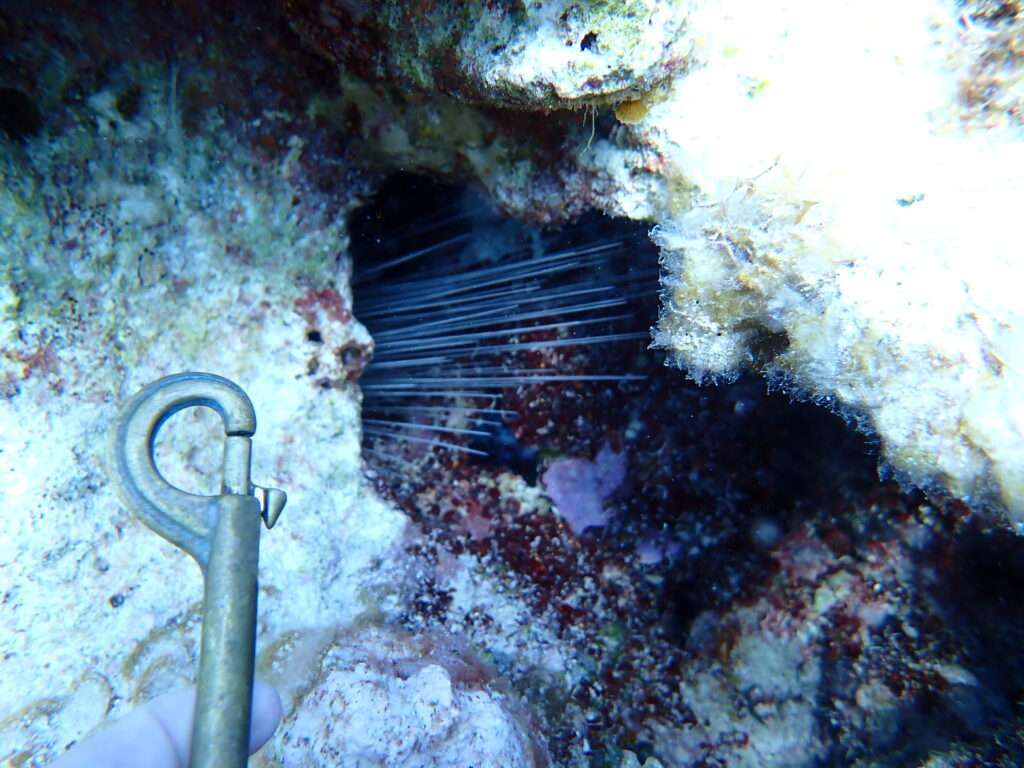
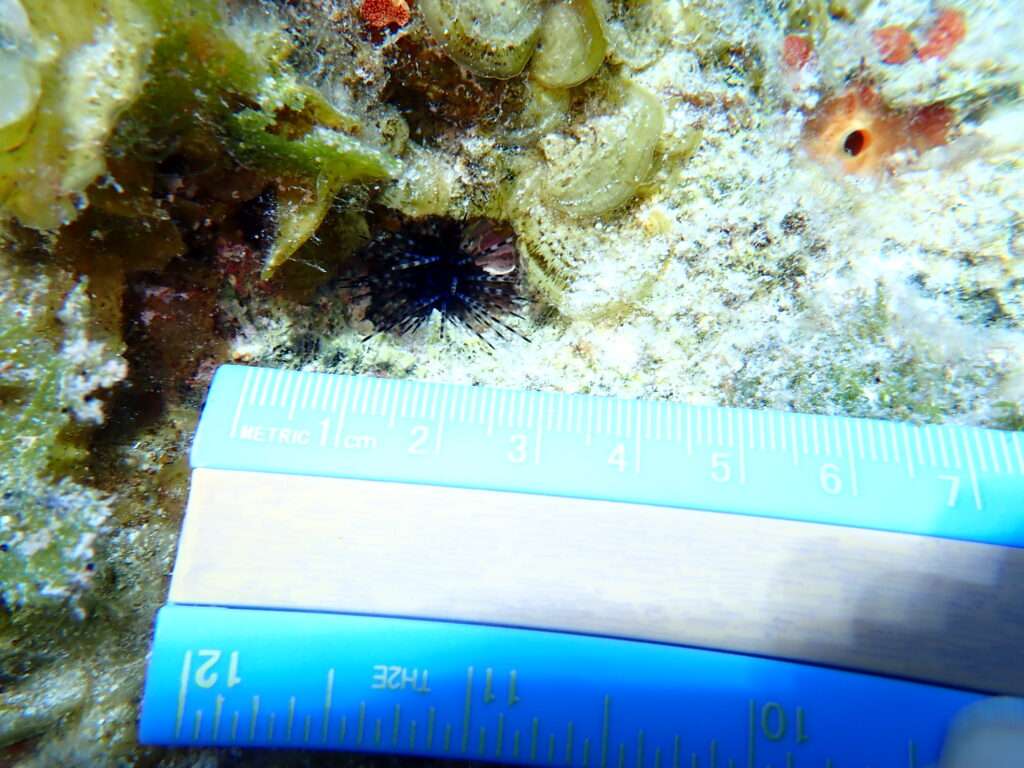
Figure 4: A Diadema antillarum urchin identified along a transect during a survey of dive site Bamboo, off the coast of South Eleuthera. Photo Credit: Natalia Hurtado. Figure 5: A juvenile Diadema antillarum urchin identified along a transect during a survey of dive site Tunnel Rock, off the coast of South Eleuthera. Photo Credit: Natalia Hurtado.
Expected Outcomes
Ideally, with the data we collect from multiple reefs we can accurately report on the status and diversity of coral grazers. With this data, we can work on finding possible solutions to the absence of grazers on coral reefs in Eleuthera.
Citations
Weiler, B. A., Van Leeuwen, T. E., & Stump, K. L. (2018). The extent of coral bleaching, disease, and mortality for data-deficient reefs in Eleuthera, The Bahamas, after the 2014–2017 global bleaching event. Springer Nature, 1(6), 1–6.
Francis, F. T., Filbee-Dexter, K., Yan, H. F., & Côté, I. M. (2019). Invertebrate herbivores: Overlooked allies in the recovery of degraded coral reefs? Global Ecology and Conservation, 17, e00593.
Hanes, S. (2023). Reefs are in trouble: Can scientists nurture more resilient coral? The Christian Science Monitor, 1(18), 1–18.
Edmunds, P. J. (2021). Recruitment hotspots and bottlenecks mediate the distribution of corals on a Caribbean reef. Biology Letters, 17(1), 1–6.
Edmunds, P. J., & Carpenter, R. C. (2001). Recovery of Diadema antillarum reduces macroalgal cover and increases abundance of juvenile corals on a Caribbean reef. Proceedings of the National Academy of Sciences, 98(1), 1–5.