Fall 2025 Student Research Project: Sharks
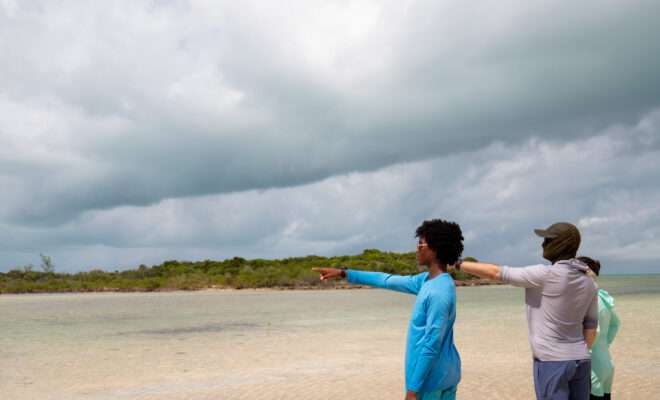
Each semester, Island School students dive into hands-on research alongside scientists from the Cape Eleuthera Institute, contributing to meaningful, place-based studies that explore the unique ecosystems of The Bahamas. These Fall 2025 research groups—focused on conch, corals, lobsters, sharks, blue economy, marine mammals, food security, and sustainable energy—are tackling real-world questions with curiosity, collaboration, and care.
In this blog series, students share their experiences, challenges, and discoveries as they navigate the research process and deepen their understanding of both science and self.

When Life Gives You Lemons, Make Science: Behavior Meets a Tourist Experience
Written by Cael Conroy, Charles Robertson, Dylan McElhinney, Ivan Prempeh, Isla Summerfield, Joseph Salyer, and Nicolas DuPont with research advisors Natascha Wosnick, Diana Kemunto, and Noah Sonnenberg
How do you feel about being in the water with sharks? This fall, our research group wanted to see if we could come up with a new tourism activity involving lemon sharks (Negaprion brevirostris) in The Bahamas.
When most people think about being in the water with sharks, they default to thinking about scuba diving, which may not be a possibility for every tourist. The need for diving certifications, extortionate costs, and an inability to dive under a certain age make diving potentially exclusive. Also, the shark diving industry does not always have a direct benefit for the Bahamian economy 1. Often, tourists will come shark diving with foreign operators, mostly from the United States, with the majority of the profits flowing into international companies instead of supporting the local economy 1. This limits opportunities for Bahamians to benefit from and participate in shark conservation opportunities related to tourism.
While these activities hold promise for boosting the local economy and raising public awareness about sharks, they often involve the use of bait to attract the animals. Previous research in other regions of the world suggests that such practices may lead to behavioral alterations and physiological stress responses in sharks 2.
However, to date, no scientific studies from The Bahamas have examined how feeding-based activities influence shark behavior. Such research could also highlight ways to support the tourism sector by offering alternatives that do not require scuba certification.
By bringing lemon sharks, one of the country’s most iconic species, closer to shore, we aim to explore how locally guided tours can generate income that supports both shark conservation and The Bahamas as a whole. By doing this, we should effectively be able to get people as close as possible to the sharks without the need for scuba diving, while making sure that such activities are safe for both sharks and people.
In order to achieve these goals our research group uses our two blocks a week to discuss scientific papers, and go out into the field to test two different attraction methods for both juvenile (Page Creek, Kemps Creek) and adult lemon sharks (Savannah Sound), one being a bait crate placed in the water so sharks can sense the food but not consume it, and the other being feeding them.

Throughout this process, we time how long it takes for the lemon sharks to show up, how long they stay around, and how long they stay after the attractant is removed from the water. We measure this visually from above using a drone and below using an underwater Insta 360 camera. We will analyze footage from both of these sources to draw conclusions about shark behaviors among each other, and towards humans, based on behavior data collected by other research groups and published previously 3,4.

So far, we have been able to attract the sharks using both methods, with preliminary results showing that placing a bait crate in the water is an effective strategy to attract the sharks while also keeping them around for long enough so that this activity can be engaging for tourists. However, when feeding the sharks, it was noticed that their behavior might change, with most sharks becoming more agitated.

Moving forward, we will continue collecting data in Page, Kemps, and Savannah Sound in order to make our database more robust with the goal of publishing these findings in the near future. We will also be interviewing local guides to give us an idea on how feasible this activity can be. Using the guides’ answers to these questions, we may refine our methods and come up with a final best practice guide to expand to other local operators. Finally, we will do a test run with kids from the Elementary Learning Center (ELC) at The Island School, allowing us to see their reactions and receive suggestions about ways to improve.

References
- Haas, A. R., Fedler, T., & Brooks, E. J. (2017). The contemporary economic value of elasmobranchs in The Bahamas: Reaping the rewards of 25 years of stewardship and conservation. Biological conservation, 207, 55-63.
- Clua, E., Buray, N., Legendre, P., Mourier, J., & Planes, S. (2010). Behavioural response of sicklefin lemon sharks Negaprion acutidens to underwater feeding for ecotourism purposes. Marine Ecology Progress Series, 414, 257-266.
- Guttridge, T. L., Gruber, S. H., DiBattista, J. D., Feldheim, K. A., Croft, D. P., Krause, S., & Krause, J. (2011). Assortative interactions and leadership in a free-ranging population of juvenile lemon shark Negaprion brevirostris. Marine Ecology Progress Series, 423, 235-245.
- Heinrich, D. D., Dhellemmes, F., Guttridge, T. L., Brown, C., & Huveneers, C. (2023). No evidence of time–place learning in juvenile lemon sharks, Negaprion brevirostris. Animal Behaviour, 203, 75-88.