Fall 2025 Student Research Project: Sustainable Livelihoods
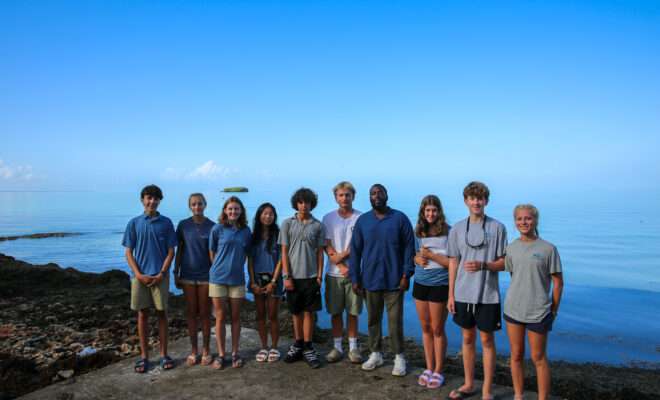
Each semester, Island School students dive into hands-on research alongside scientists from the Cape Eleuthera Institute, contributing to meaningful, place-based studies that explore the unique ecosystems of The Bahamas. These Fall 2025 research groups—focused on conch, corals, lobsters, sharks, blue economy, marine mammals, food security, and sustainable energy—are tackling real-world questions with curiosity, collaboration, and care.
In this blog series, students share their experiences, challenges, and discoveries as they navigate the research process and deepen their understanding of both science and self.

From Vulnerability to Resilience: Rethinking Fisher Support in a Changing Climate
Written by Bear Gyves, Emerson Murray, Heidi Woltehagen, Henry Hyland, Skye Lonergan, Sydney Gilpin, Carson Kaplan, and Jenny Wang with research advisors Michael Bowleg, Jr. and Mackenzie Dyches-Brookes
Across The Bahamas, small scale fishers are the heartbeat of coastal life. Fishers rely heavily on marine resources such as lobster, conch and finfish that supports their families, sustain local economies and carry very deep cultural meaning (Figure 1).
However, as hurricanes become stronger and more frequent due to climate change in Small Island Developing States (SIDS) like The Bahamas, many fishers find themselves in a highly vulnerable position post storms, often without formal support.

In recent years, storms like Hurricane Dorian (Figure 2) have shown that Bahamian fishers are not only on the frontlines of climate change but can be the among the least supported when disaster strikes. Our research explores what Bahamian fishers need before and after storm events and how national policy can evolve to protect their livelihoods.

For most fishers, storm preparation starts with securing boats, hauling traps, and protecting what they can (Figure 3). This storm prep while very crucial consumes resources which for small scale fishers can be limited.
To gain an understanding of fisher experiences, we have began conducting fisher interviews across the island of Eleuthera. Initial things which were mentioned by fishers included obstacles such as limited financial support and limited storage infrastructure. Few programs provide pre-storm assistance, grants, or insurance to protect these vital livelihoods. As one fisher said, “When the storm comes, we just pray and start over when it’s done.”
Following extreme weather climatic events, fishers often find their gear destroyed or lost, boats damaged, and fishing grounds altered. In some cases, with minimal to no formal safety net, recovery can be a slow and arduous process. Fishers mentioned challenges such as:
- Disrupted income
- Difficulty accessing credit to replace lost gear
- Delayed or fragmented government response
- Ecosystem damage
Many fishers mentioned community and family networks as being the only reliable source of support. While this local reliance is powerful, it might not be enough to rebuild livelihoods and an industry that underpins the Bahamian food security and cultural identity.

Outside of speaking to fishers, we will also be interviewing government stakeholders who work in the marine resource space. This will allow the mapping of what support mechanisms exist and where barriers or gaps remain.
You may ask: why does all this matter? Supporting fishers means supporting the communities, families, and ecosystems that depend on them. As The Bahamas faces a future affected by climate change and more frequent storm events, building resilience must start with understanding what the people impacted need the most.
By listening to fishers’ stories and linking them with governmental insights, this research project bridges the gap between policy and lived experiences. It highlights that it is not just rebuilding boats, it’s about developing systems that protect people (Figure 4).

Building a More Resilient Future
The next phase of this work focuses on turning research into action. By engaging agencies like the Department of Marine Resources, the National Emergency Management Agency, and local cooperatives, this project seeks to co-develop strategies that can strengthen fisher resilience.
Some of the potential policy solutions identified include:
- Establishing a Fisher Recovery Fund for pre- and post-storm assistance
- Creating fisher registries and rapid assessment protocols to target aid efficiently
- Promoting mangrove and ecosystem restoration to protect harbors and nursery habitats
- Integrating climate insurance or emergency micro programs for small-scale fishers
Supporting fishers means supporting Bahamian food security, culture, and the blue economy. By listening to those most affected, The Bahamas can design policies that not only rebuild livelihoods but also strengthen resilience for generations to come.