Each semester, Island School students dive into hands-on research alongside scientists from the Cape Eleuthera Institute, contributing to meaningful, place-based studies that explore the unique ecosystems of The Bahamas. These Spring 2025 research groups—focused on conch, stingrays, coral grazers, corals, lobsters, sharks, and sustainable energy—are tackling real-world questions with curiosity, collaboration, and care.
In this blog series, students share their experiences, challenges, and discoveries as they navigate the research process and deepen their understanding of both science and self.
Increasing Renewable Energy Production for The Island School with a Solar System at CEI
Thomas Sheets, Veronika Elias, Wyatt Thornton, Victor Lu, Willa Schwartz, Millie Hacking, Remi Helms, Sadie Kelley
What is energy and how do its sources affect our environment? Energy is the ability to do work and cause change. It is the source of electricity and power in our homes and daily lives. Energy is helpful and necessary worldwide, however, the ways we obtain energy can be harmful. When fossil fuels are burned to harness their energy, greenhouse gases are emitted into the atmosphere where they become trapped in the troposphere. This contributes to global warming and the climate-altering effects that come with it, including increased severe weather events and ecological damage.1 Many of the effects of climate change are particularly harmful to Small Island Developing States (SIDS) – islands that often share similar sustainable development challenges. Among the impacts of climate change on SIDS are elevated temperatures, sea level rise, ocean acidification, coral bleaching, altered precipitation patterns,increased hurricane intensity and frequency, declining biodiversity, etc.1
Let’s quickly highlight two of these. Coral bleaching is the phenomenon by which warming oceans cause the vital microorganisms in coral to die. When too many of these microorganisms die, corals lose their color and become more susceptible to damage.2 Coral bleaching may impact tourism in The Bahamas, potentially putting thousands of people out of jobs and causing economic strife as tourism makes up over 45% of the national GDP in The Bahamas.3 This is part of what is called a ‘Blue Economy,’ where the economy in The Bahamas and other SIDS is dependent on the ocean and the resources it brings. This can be in the form of cruise ships, fisheries, imports, and more.3 Another impact of climate change on SIDS is altered precipitation. The total area impacted by flooding on SIDS is expected to more than triple by 2050.4 Presently on Eleuthera, we are witnessing a contrasting, but equally concerning problem, a prolonged dry season and lack of rain.
In order to combat these projections, the Bahamian government has set a goal to increase clean energy production to 30% by 2030.5 This is an important and ambitious goal in a country that currently gets less than 1% of its electricity from renewables.6
Here on Eleuthera, The Island School is trying to lead by example by progressing toward a more renewable electricity mix. In 2023, 88% of The Island School’s electricity usage came from non-renewable energy sources, and only 12% came from renewables (solar and wind). A year later, a renewed focus on renewables produced a cleaner mix: 72% from non-renewable sources, and 28% from solar and wind.7
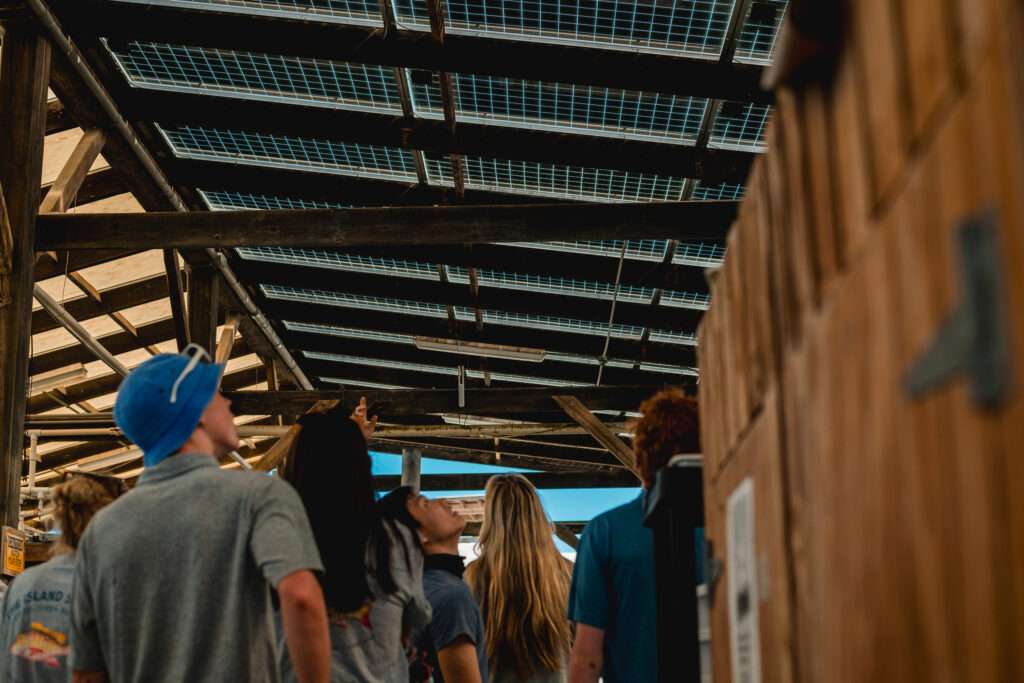
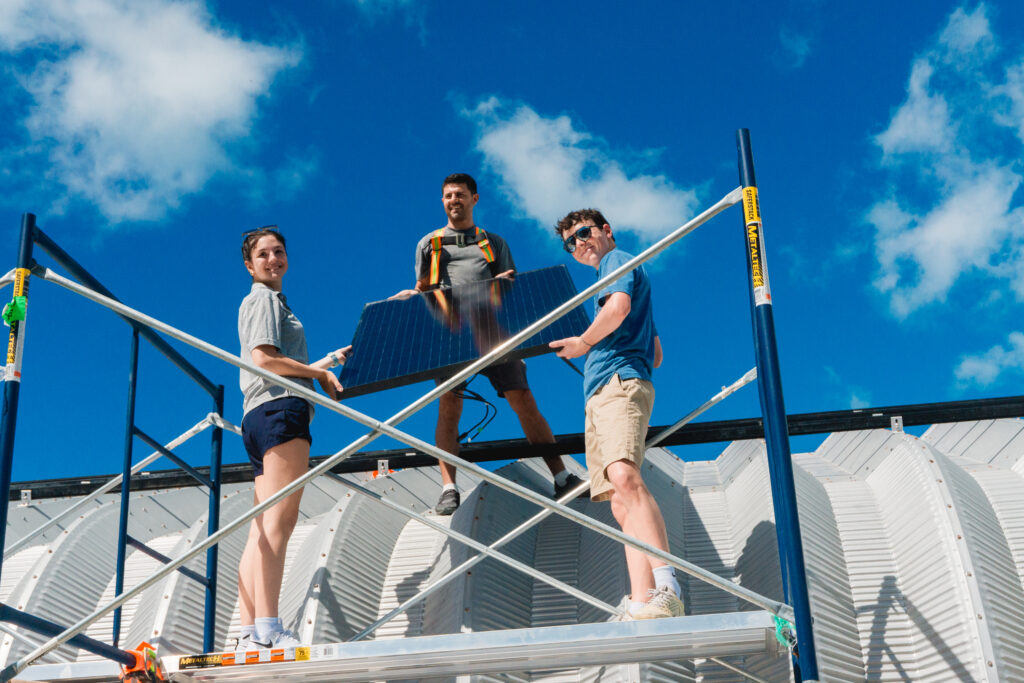
The Spring 2025 Semester energy project hopes to continue this positive trend. As a team, we are installing a new solar PV system on the Cape Eleuthera Institute (CEI) campus, the scientific hub of research and innovation at The Island School. It will include 20 solar panels, 300 Watts each. The Tin Can, a storage facility for marine research, has been selected as our project site. This building is low to the ground, unshaded, lends itself to an easy installation, and it houses several cold-storage freezers that our solar electricity can help to power.
Research Group Methods
We began our project by reading and discussing a variety of works on relevant subjects. We dove into how solar panels work, voltage and current, ways to reduce CO2 emissions in The Bahamas, the importance of renewable energy here on Eleuthera, environmental justice, and other relevant topics.
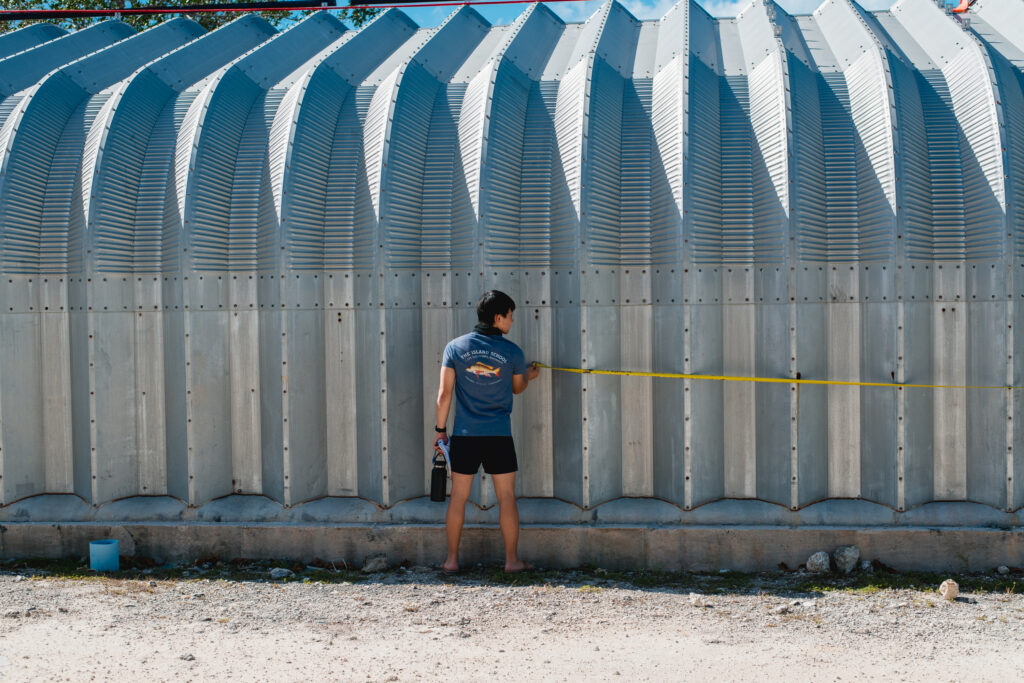
During our initial visit to the installation site, we took preliminary measurements and considered the logistics of our installation. We then created a list of materials including solar panels, mounting system components, tools and installation equipment, electrical supplies, and an inverter. Based on our building and solar panel measurements, we calculated that the best orientation for the panels would be two horizontal rows of ten. Due to the east-facing orientation of the system, it should be able to create more solar energy in the morning, filling a gap in our current production.
Project Outcomes
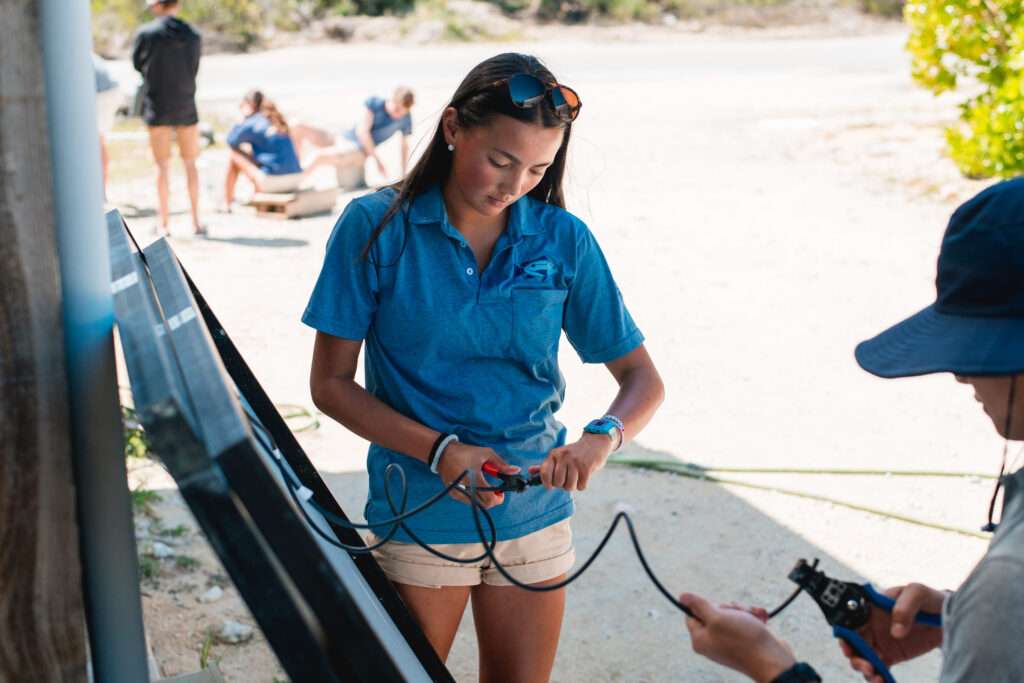
As we are writing this blog, we are almost finished with the installation. Our goal is to begin producing power soon, so that we can generate data while away on expeditions. When we return, we will collect and analyze the data to measure the impacts of our new system. These should include a cleaner electricity mix, reduced carbon footprint, and cost savings. Ideally, this new solar system will add around 8% more solar energy to our campus. However, this number is only an estimate made from the current solar data on campus. We are ultimately striving to create more sustainability for not only our campus but the wider community on Eleuthera.
We hope to be a symbol and example for how we can play our part and support the broader community through a lens of energy justice. Energy justice is defined as the goal of achieving equity in both the social and economic participation in the energy system, while also remediating social, economic, and health burdens on those historically harmed by the energy system.8 In simpler terms, energy justice is the idea that everyone, of different incomes and different locations, has equal access to affordable and clean energy resources. This includes, but isn’t limited to, electricity, washers and dryers, and air conditioning. One of the motivations behind our project is a genuine interest — one which we all collectively share — in helping our greater community. Eleuthera, a remote island with a dependence on foreign fossil fuels, will benefit tremendously from the clean energy transition away from diesel. We at The Island School are hoping to lead by example, harnessing the power of the sun and becoming as solar powered as possible.
We end this blog post with a quote from one of our readings: “Respiration—the source of energy that lets us farm and dance and speak. The breath of plants gives life to animals and the breath of animals gives life to plants. My breath is your breath, your breath is mine.”9 Recognizing the reciprocity of our environment, our solar system is a step in the right direction towards a more renewable future.
Citations
Lee, B., Ziter, B. (2025). Energy Research Classroom Content.
Lansdown, E. (2025). Marine Ecology Classroom Content.
Bethel, B.J., Buravleva, Y., Tang, D. (2021). Blue Economy and Blue Activities: Opportunities, Challenges, and Recommendations for The Bahamas. Water. 1-15.
Vousdoukas. M, Athanaslou. P. (2023). Small Island Developing States Under Threat by Rising Sea Levels in a 1.5ºC Warming World. Nature Sustainability. Volume 6, 1552-1564.
Government of The Bahamas. (2012). The Bahamas National Energy Policy 2013-2033. https://www.bahamas.gov.bs/wps/wcm/connect/c0934c9b-fc0e-4496-90e7-5d273c57553a/energypolicy.pdf?MOD=AJPERES.
Boretti, A., Al Zubaidy, S. (2021). Reducing CO2 Emissions to a Sustainable Level in The Bahamas Islands. Current Research in Environmental Sustainability. Volume 3, 1-8.
Spring 2024 Energy Research Project. (2024). The Island School Semester Program.
Stanford University. (Accessed 2025). Energy, the Environment, and Justice. https://understand-energy.stanford.edu/why-we-care/environment.
Kimmerer (2013). Peoples of Corn, Peoples of Light. (Chapter 28). Braiding Sweetgrass. 346-352.