Spring 2025 Student Research Project: Lobsters
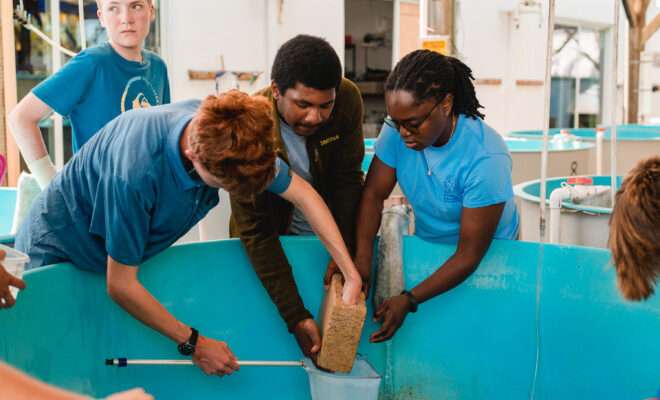
Each semester, Island School students dive into hands-on research alongside scientists from the Cape Eleuthera Institute, contributing to meaningful, place-based studies that explore the unique ecosystems of The Bahamas. These Spring 2025 research groups—focused on conch, stingrays, coral grazers, corals, lobsters, sharks, and sustainable energy—are tackling real-world questions with curiosity, collaboration, and care.
In this blog series, students share their experiences, challenges, and discoveries as they navigate the research process and deepen their understanding of both science and self.

Can Black Solider Fly Replace the Protein in Feed for the Caribbean Spiny Lobster?
Conrad Cestar, Anderson Horn, Matthew Manning, Miles McMoore, James Opp, Maeve Upton
Lobsters: they’re delicious, they’re valuable, but how much do you really know about them? Spiny Lobsters are one of the world’s most valuable seafood, because of their strong demand and limited supply. While most of the lobster industry in the Bahamas primarily relies on wild capture, another method that is emerging is aquaculture – the cultivation and harvesting of organisms in a controlled water environment.
Despite this, there is little to no research in many aspects of raising these healthy, big, tasty lobsters. Currently, trash fish (fish that is not commercialized for food/not eaten) is caught and used as the main source of protein for most fresh feed. However, in the long run, this is not sustainable due to the detrimental impact overfishing trash fish has on ecosystems, and so an alternative feed is required. Since lobster fisheries and hatcheries rely heavily on wild caught seafood to feed to their lobsters, this can become extremely expensive and hard to maintain. That’s where our research team comes into play with, of course, the black soldier fly. The black soldier fly (BSF) has been a promising candidate to substitute for trash fish due to its high protein and lipid content, low feed conversion ratio, and wide-spread availability.
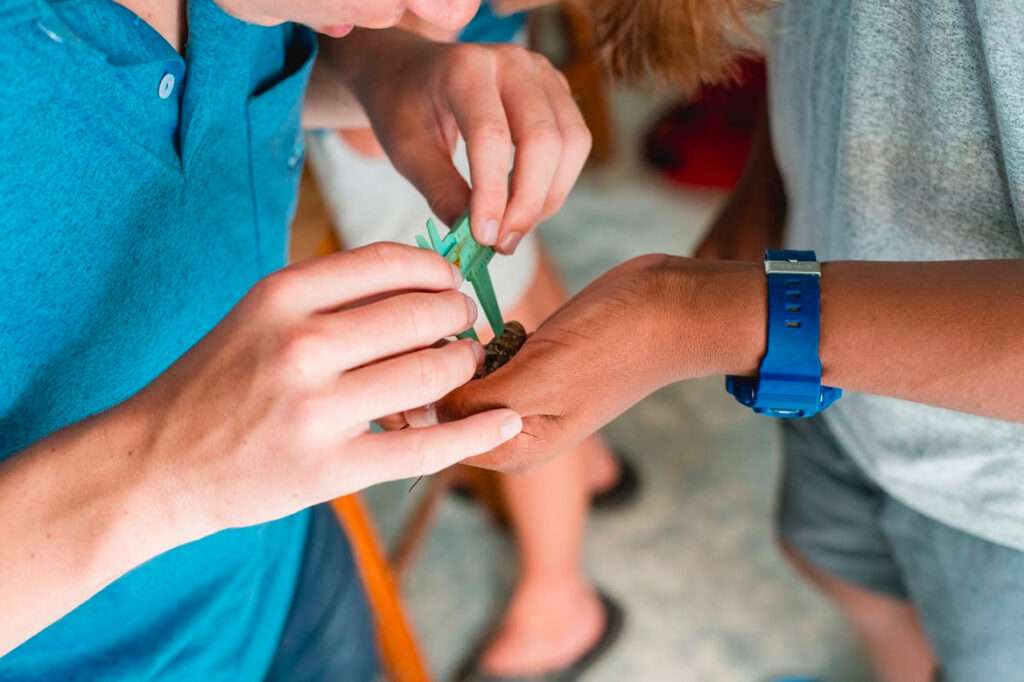
Although prior research seems to point to the fact that it is possible to use BSF as a replacement for other proteins, this idea is still fairly new and niche. Due to this, more experimentation needs to take place to ensure this is a suitable feed. Our research is aimed at comparing the effects three different feeds have on the growth (size and weight) of these spiny lobsters. To discover this, the lobsters will be separated into three categories: those fed snails, those fed a pelleted mixture of green muscles and soybean, and those fed a pelleted mixture with 50% of the protein supplemented by BSF. These lobsters will then be fed twice a day and measured from the middle of their eyes to the end of their carapace and weighed weekly.
If we conclude that the black soldier fly is a suitable replacement of protein, we can improve lobster aquaculture in its entirety due to the more sustainable and cheaper protein that this feed can provide.
Aisyah, H., Athirah, Z., Hanani, W., Arshad, S., Hassim, H., Nazarudin, M., Ina-Salwany., M. (2022). The effect of feeding black soldier fly larvae on growth performance, protein, and fat content of red hybrid tilapia (Oreochromis spp.) Veterinary World, 15(10), 2453 – 2457. www.veterinaryworld.org/Vol.15/October-2022/11.pdf.
Astuti, N., Sudewi, S., Salmet, B., Fahrudin, F., Giri, I. (2024). The impact of fresh and artificial diet on growth and survival rate of spiny lobster, Panulirus homarus reared in floating net cage. BIO Web of Conferences BIO Web of Conferences , 1-9. https://doi.org/10.1051/bioconf/20248703022.
Stadtlander, T., Stamer, A., Buser, A., Wohlfahrt, J., Leiber, F., Sandrock, C . (2017). Hermetia illucens meal as fish meal replacement for rainbow trout on farm. Journal of Insects as Food and Feed. 3(3), 165-175.